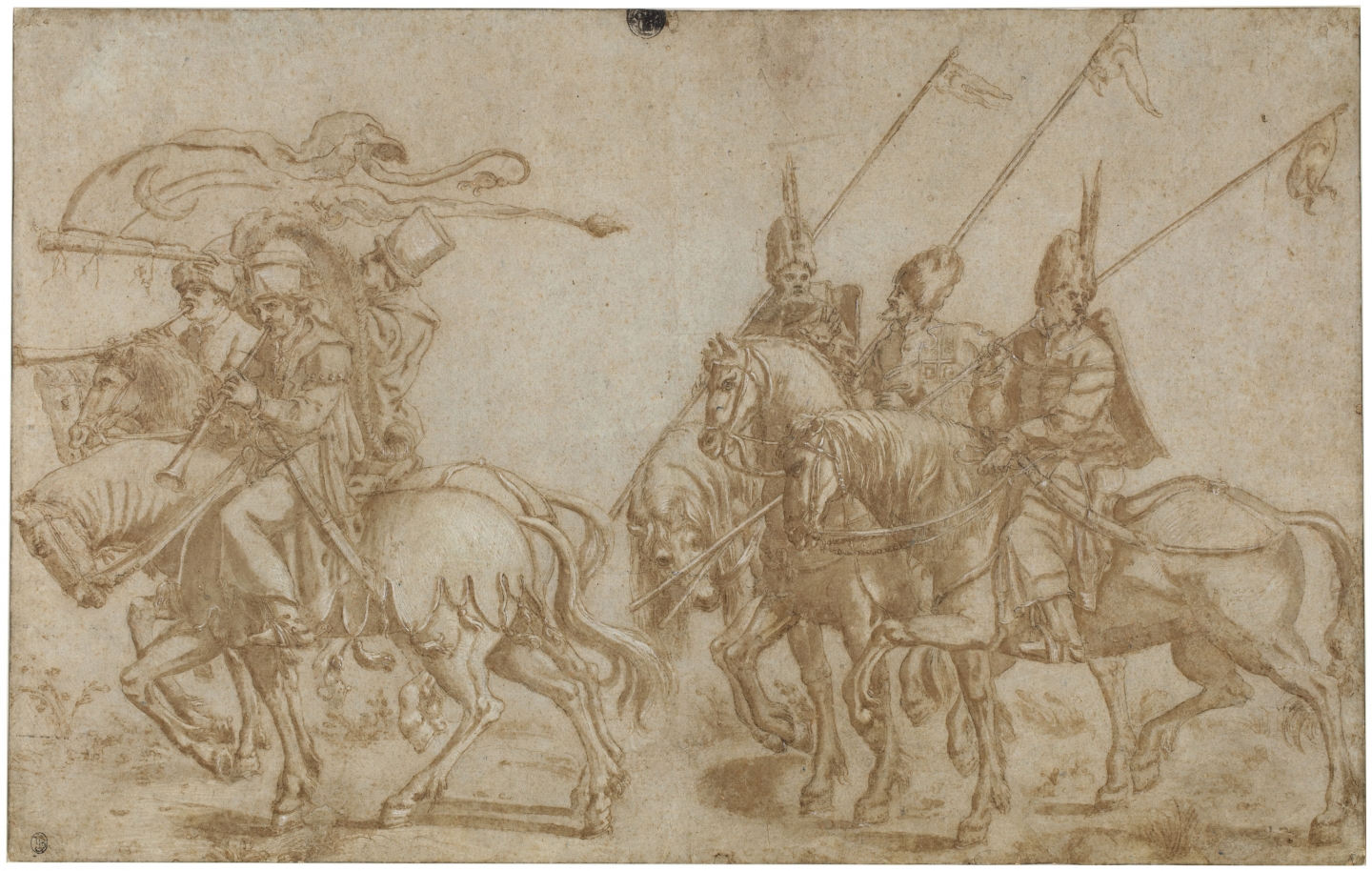
Born in Groningen around 1500, Jan Swart resided in Gouda around 1522-1523. It was almost certainly in the first half of the 1520s that he made a trip to Venice, as noted by Karel van Mander in his biography of the artist.[1] An accomplished draftsman and wood engraver, Swart produced numerous illustrations published in Antwerp, where he lived from 1524 to 1526 and then from 1535 to 1560. His paintings, numerous drawings, and engravings demonstrate the transition from a certain mannerism characteristic of late Gothic to the influence of Albrecht Dürer and the assimilation of the Italian High Renaissance, with a strong influence from the art of Jan van Scorel during the final years of his career.
Our drawing depicting a procession of six Turkish horsemen is directly related to the series of woodcuts that Karel van Mander mentions in his biography of Jan Swart as the “Group of Turkish horsemen armed with bows and quivers… who are treated with infinite wit.”[2] This series of five woodcuts depicts the procession of the Turkish emperor Suleiman the Magnificent (1495–1566) and was published by Willem Liefrinck in Antwerp in 1526.[3]
The horsemen are depicted in a frieze, three by three on each plate, with the exception of Suleiman the Magnificent, who rides alone with an infantryman on the third plate. The fourth and fifth plates show three turbaned archers and three Arab spearmen. Our drawing is identical to the first two plates, with three trumpeter players leading the procession, followed by three Mamluk horsemen, the last of whom turns his head backward, toward Suleiman the Magnificent, who was to follow in another drawing, now lost. In the engraved series, as in our drawing, the horsemen ride from right to left. Since the height of the drawing and the engraving is virtually identical, our plate could have served directly as a sketch for transferring the image onto the woodblock.
The year 1526, which corresponds to the publication of this series, is also that of the Battle of Mohács (August 29, 1526), where Suleiman's troops conquered Hungary. A portion of Western Europe was then living under Turkish threat, and three years later, Turkish armies would besiege Vienna (1529). From the second half of the fifteenth century onward, commercial, diplomatic, and cultural exchanges between Europe and the Ottoman Empire had intensified, and many of Swart van Groningen's religious works depict Turks and testify to his fascination with the Orient.[4] Historians have even considered the possibility that Swart extended his journey from Venice to Constantinople. However, it is more likely that the portrait of Suleiman and his guard was not painted from life, despite its great realism and the attention paid to the clothing.[5] These costumes reveal a profound knowledge and observation of authentic costumes, such as the detailed decorations on the caftans, the tall fur-lined helmets of the Mamluk cavalrymen, and those adorned with feathers corresponding to the solaks (sergeants) and janissaries of the Ottoman army. These costumes could also be observed in Venice thanks to the numerous Turks who populated the city for commercial or diplomatic reasons. To create this procession, Swart drew on a variety of sources of inspiration, utilizing the visual repertoire provided by Italian paintings and engravings, as well as the twenty-eight woodcuts by the Dutch engraver and cartographer Ehrard Reuwich illustrating the Peregrinatio in Terram Sanctam (1486). Finally, the last source of inspiration is, of course, the Triumphal Procession of Emperor Maximilian I, executed from 1516 onwards. One hundred and ten miniatures by Albrecht Altdorfer served as the basis for a frieze of one hundred and forty-seven woodcuts assembled into a frieze over fifty-seven meters long, created by, among others, Hans Burgkmair the Elder and Albrecht Dürer. The same conventions are found in the arrangement of the ground and the horsemen, but the procession moves in the opposite direction.[6]
The prints of the Procession of Suleiman met with undeniable success, as the woodcuts were reproduced and etched in 1530 by Daniel Hopfer (c. 1470–1536).[7] Two drawings by an anonymous German artist, copying the Three Arab Horsemen and Suleiman, circa 1550–1560, are also preserved in Hamburg (Kunsthalle, Kupferstichkabinett).[8] The Mamluk motif was reused by Erhard Schön in his engraving Two Janissaries and Two Prisoners (1530), illustrating the Siege of Vienna in 1529.[9] This legacy continued in 1684 when Daniel Hopfer's copperplates were reprinted by Daniel Funck in Nuremberg.
The few notable differences between our drawing and the woodcut, particularly in the details of the faces, are easily explained by the more subtle technique achieved with pen and wash, as opposed to the more linear rendering of wood engraving. The same qualities of execution in the face and hands are found, in particular, in the drawing of Pontius Pilate washing his hands (pen and brown ink, heightened with white, 340 x 130 mm, Oxford, Ashmolean Museum). However, Dr. Gaylen Vankan, author of a thesis on Swart van Groningen defended at the University of Liège in 2023, remains "very cautious regarding an attribution to the master's hand."[10][11] He notes that our Horsemen stand out stylistically from the artist's other known drawings, which are characterized by thick pen outlines and volumes and shadows modeled with ink washes. The comparison is made all the more difficult as the earliest known drawings by Swart are no earlier than the years 1530-35, whereas ours, datable to 1526 at the latest, would constitute the earliest known drawing by the artist.
Related works
J. Swart van Groningen, Three Trumpeters Riding to the Left, woodcut, 349 x 271 mm, Antwerp, 1526
J. Swart van Groningen, Three Mamluk Horsemen, woodcut, 354 x 273 mm
[1] G. Vankan, « Investigating Jan Swart’s Stay in Venice », Accademia Raffaello. Atti e studi, XXI, 2022, pp. 121-138.
[2] C. van Mander, Le Livre des Peintres. Vie des peintres flamandes, hollandais et allemands (1604), Paris, 1884, t. I, p. 254
[3] K.G. Boon (éd.), Hollstein’s Dutch and Flemish Etchings, engravings and woodcuts, vol. XXIX, Blaricum, pp. 111-113, cat. 8-12
[4] G. Vankan “Jan Swart van Groningen Facing Orient. Encounter, Assimilation and Reinvestment of a Foreign Culture”, Workshop for the Early Modern Period, Cambridge, University of Cambridge, 19 octobre 2020 (non publié, seul le résumé est consultable).
[5] T. B. Husband, The Luminous Image. Painted Glass Roundels in the Lowlands, 1480-1560, p. 166
[6] E.S.Jacobowitz et S.L.Stepanek, Lucas van Leyden and his contemporaries, National Gallery of Art, Washington, ex. cat. 1983, no. 136.
[7] Hollstein German 66-2
[8] https://online-sammlung.hamburger-kunsthalle.de/de/objekt/29337/drei-arabische-reiter-mit-lanzen-und-fellmuetzen?term=lorch&context=default&position=1
[9] T.B. Husband, op. cit., p. 169.
[10] G. Vankan, Jan Swart van Groningen, peintre-inventeur de la Renaissance néerlandaise, Thèse de Doctorat, sous la dir. D. Allard, Université de Liège, 2023.
[11] Nous remercions Gaylen Vankan pour son avis et ses indications sur notre dessin donnés d’après une photographie numérique, dans un courriel daté du 27 octobre 2025.