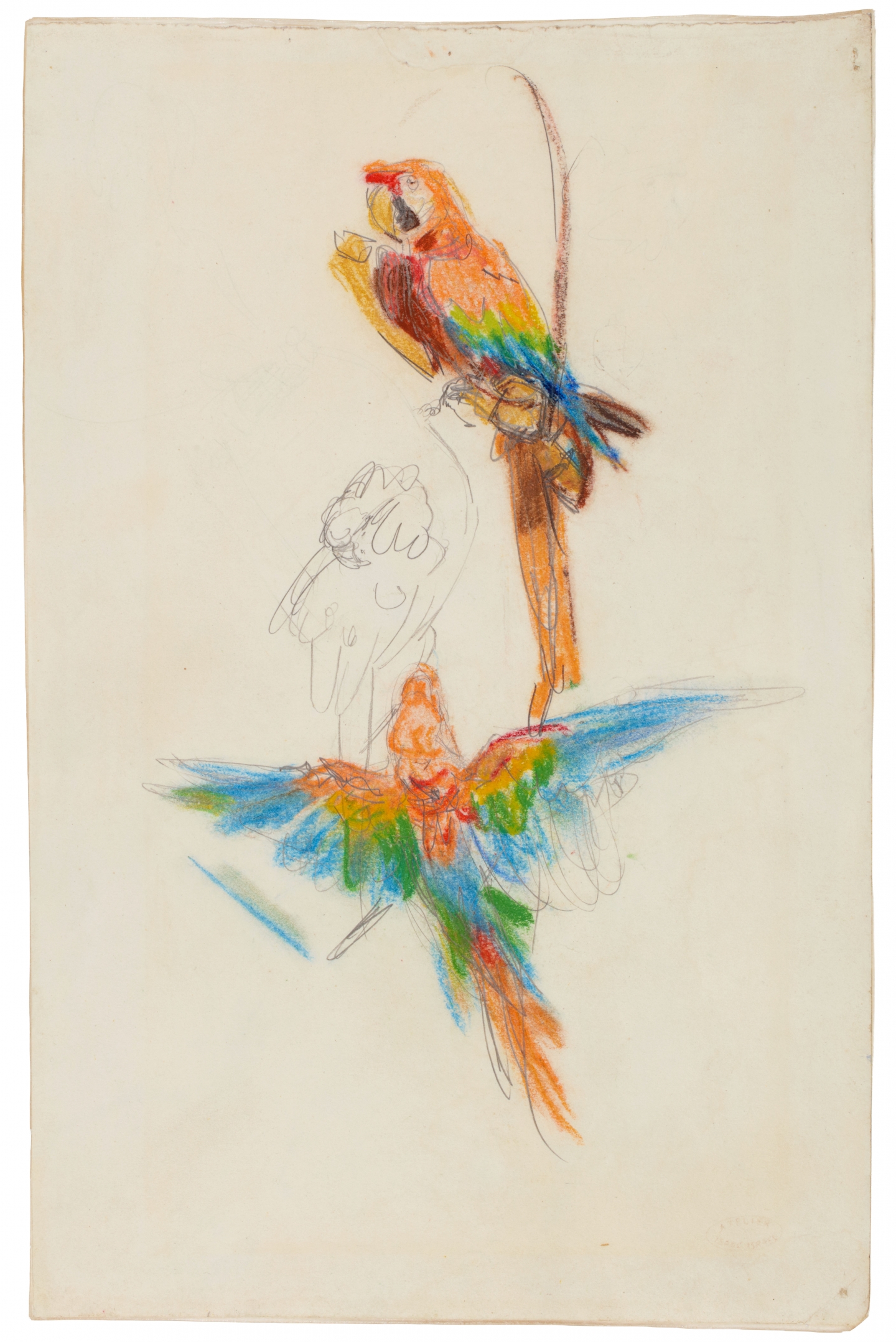
The impressionist Isaac Lazarus Israels had studios in Paris and London, traveling abroad to Spain, Italy, Northern Africa, Swiss, Scandinavia and the Dutch Indies before finally settling in The Hague in 1916 in the house were he was raised. He must have recalled the family friend Max Liebermann's visits to Artis Zoo in Amsterdam, painting it's keeper with parrots, which may have inspired Isaac when he settled in his father's (Josef Israels) house. The Hague Zoo was located across the Koninginnegracht canal, opposite to the house of Josef Israels and Isaac would spend a great amount of time there
In 1862, The Hague also acquired its own zoo, following Amsterdam and Rotterdam. The Hague Zoo was located across the Koninginnegracht canal, opposite the house of Isaac's father, Jozef Israels. Later, long after his father's death, when he moved into his childhood home and worked in his father's studio, he could often be found at the zoo. The garden became a place of entertainment for all walks of life, a rarity in 19th-century society. For both the middle and upper classes, a day at the zoo was a popular outing, for which people dressed in their Sunday best. Parrot Avenue began at the entrance, where the birds welcomed visitors with a Hague accent. The keeper, Mr. Ponsen, put on a show when he returned his parrots to their cage at the end of the day. The sun-drenched avenue was an ideal subject for Israels; the keeper, with all his different birds, a feast of color. With just a few effective brushstrokes, he virtuously suggested the flapping of the colorful wings and tail of the red-and-blue macaw.