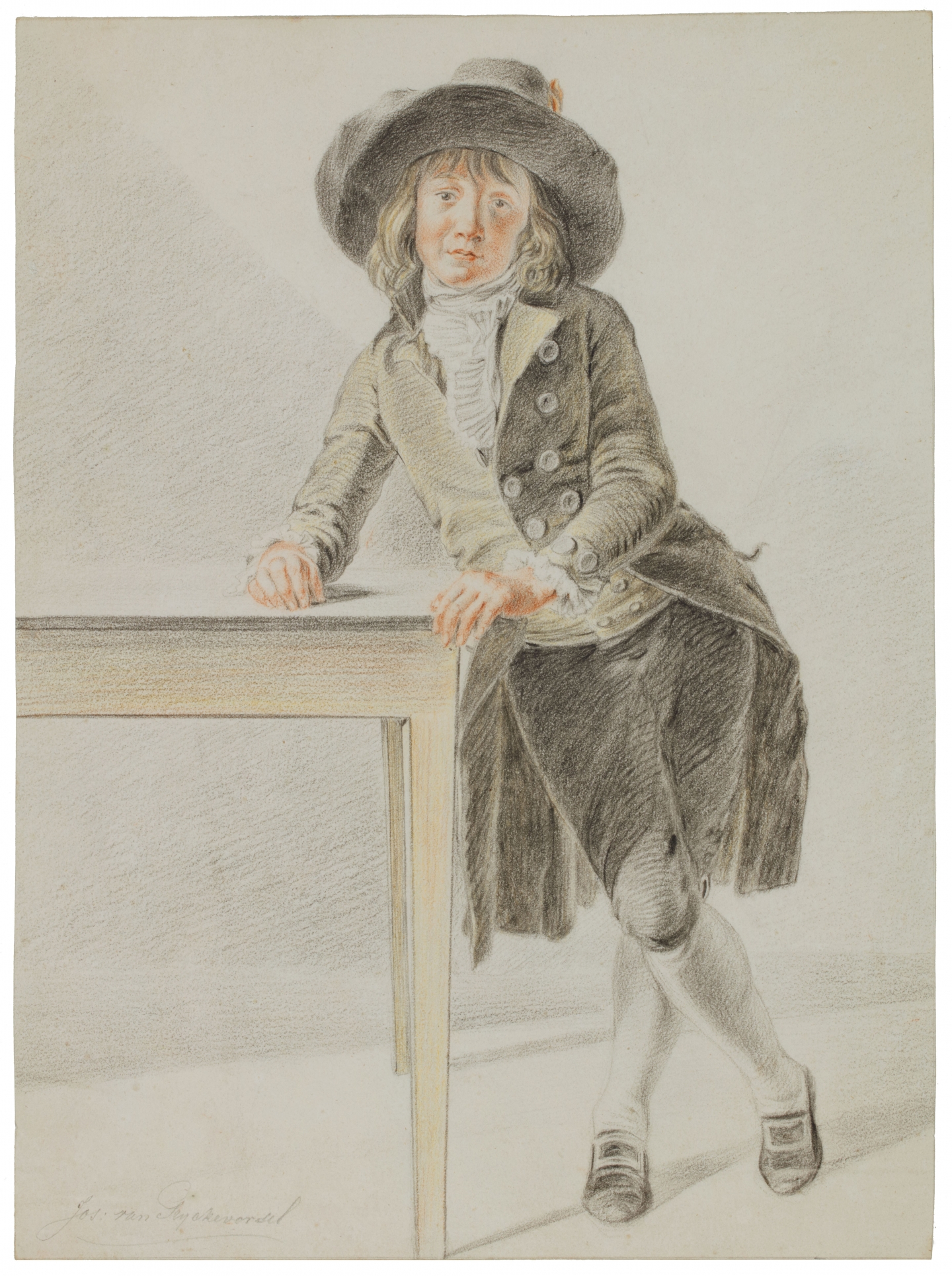
Son of the wine merchant and governor Thomas Cornelis van Rijckevorsel (1751-1818) and Anna Petronella Vermeulen (1760-1792), Jacobus Josephus baron van Rijckevorsel, heer van Rijnsburg, married Catherina Valentina van der Kun (1792-1813) in 1811 and after Catharina passed away he married Hendrica Petronella Veronica van der Oosthuyse, vrouwe van Rijnsburg (1793-1829) in 1814. With both women Jacobus had a total of three daughters and four sons, two of who would become artists as well.
Van Rijckevorsel was active as a tradesman, held various political positions and had a profound interest in Architecture and was an amateur artist and mainly draughtsman who produced litho's, drawings and stained windows. He also taught both his sons Augustinus Josephus Aloysius (jonkheer) (1819-1892) and Joannes. The latter together with whom he exhibited at the Tentoonstelling van Levende Meesters, Den Haag in 1839 and 1841 (Exhibition of Contemporary Masters, The Hague). Jacobus was also entitled Knight in the Order of the Dutch Lion in 1824 and ennobleded to the Dutch peerage on 18 February 1831 and on 15 September 1842 granted the title of baron by primogeniture.
A dessus de porte stained window by Rijckevorsel preserved at Castle Heeswijk, depicting a seated Angel with Coat of Arms for Andreas baron van den Bogaerde van Terbrugge (Gent 1787-1855 Heeswijk), governor of Noord-Brabant and his wife Eugénie Papeians de Morchoven dit van der Strepen (Gent 1795-1843 Heeswijk). Jacobus als made a splendid large litho of the Old Exchange of Rotterdam (De Beurs en beursbrug te Rotterdam), ca. 1840.
Three years prior to his death, van Rijckevorsel designed the Family tomb of van Rijckevorsel, which was realised behind the Sint-Petrus'-Bandenkerk in Rijnsburg in 1859.
It remains a mistery who taught Jacobus the basics of arts and contrary to being noted as an amateur draughtsman, the present splendid drawing of a dreamy boy is of such notable quality and artistic refinement one cannot but dismiss the remark of an amateur artist. Dressed in 18th century garment, van Rijckevorsel appears to have been inspired by his 18th century predecessors.