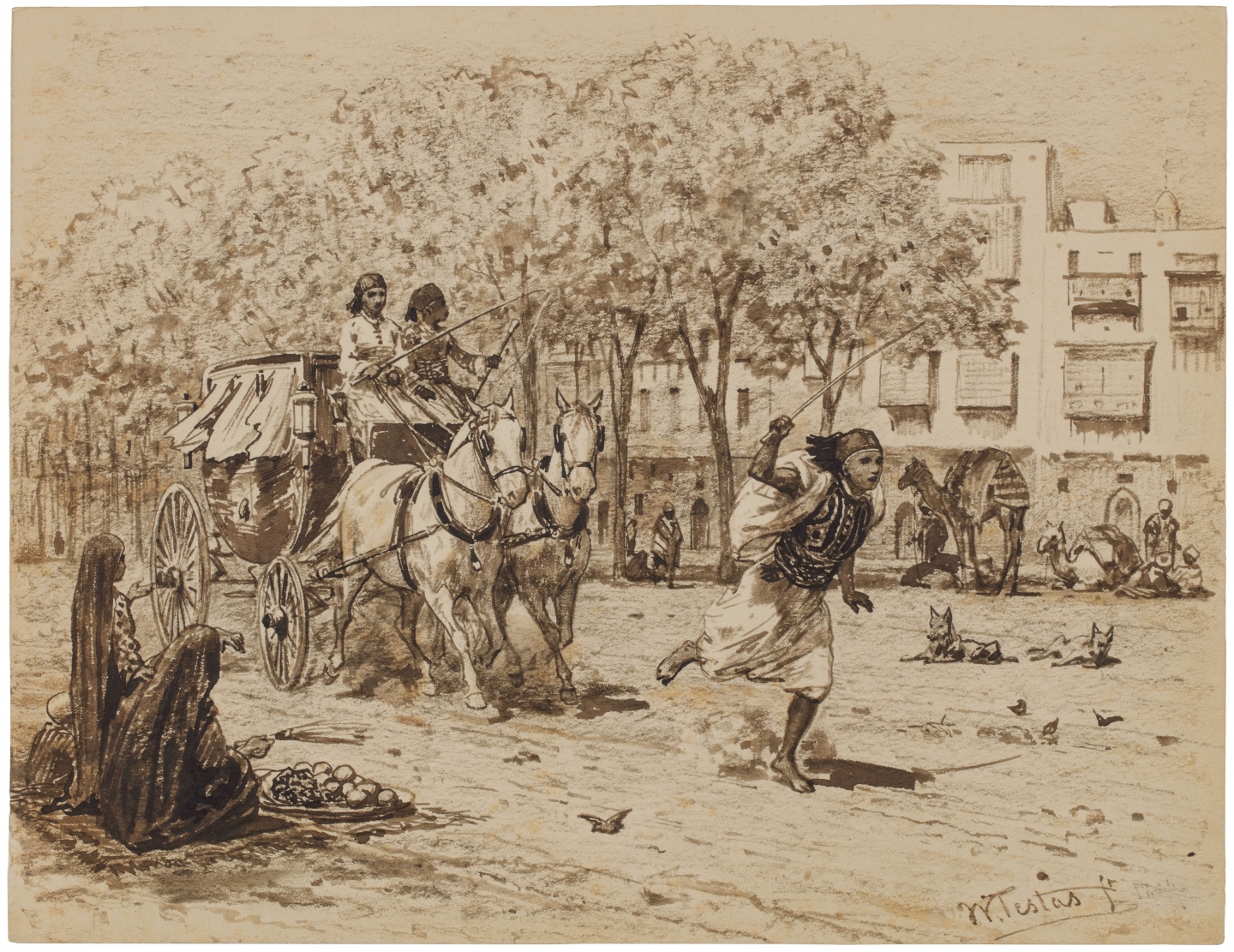
De Famars Testas grew up in a wealthy family. From 1851 to 1856, he studied at the Teeken-Academie in The Hague under Joseph van den Berg, where he developed into a skilled draftsman and painter of figures and animals.
In 1858 De Famars Testas traveled with the French Egyptologist, author and adventurer Émile Prisse d'Avennes (1807-1879) who had lived and worked in Egypt since 1827 on a scientific expedition through Egypt. During his stay in Egypt, he developed an interest in the archaeological culture of Egypt and Arabia. As a result of his research and excavations, he received financial support from the French government and was able to employ assistants to assist him with his research De Famars Testas initially planned to travel at his own expense so he could make sketches and studies for himself, but just before departure, the expedition's artist canceled. Prisse d'Avennes demanded that De Famars Testas take over his scientific work. Through his work for the Egyptian government and his extended stay in Egypt, Prisse d’Avennes possessed an unparalleled knowledge of the country, its language, and its customs. They were accompanied by the French photographer Éduard Athanase Jarrot (1835-1873), who recorded the sojourn with his photos. This trip, initially intended to last only five months, ultimately extended to two years. During this period, he visited numerous monuments of Islamic and ancient Egyptian culture, which he documented in his drawings and watercolors. These sketches and watercolours would become a rich source of inspiration for commissions.
After returning to Europe in 1860, Prisse used the vast amount of information and images they had gathered for two lavish publications: L’Art Arabe (1877) and Histoire de l’Art Égyptien (1878). Due to his long stay in Egypt and his training under Prisse d'Avennes, Willem became the first Dutch artist to specialize in Orientalism, a 19th-century art movement particularly popular in England and France. Based on his experiences in Egypt, and with the help of drawings, photographs, and other resources, he offered a seemingly realistic view of life in the Middle East in watercolors and oil paintings after returning to Europe.
Several years later, in 1868, De Famars Testas was invited by the French orientalist painter Jean-Léon Gérôme to join him on his journey through Egypt, Palestine and Syria. The journey lasted from 1 January to 2 July 1868 and provided him with new impressions and inspiration. Upon returning to Europe, he settled for a time in Brussels, where the artistic climate for his Orientalist work was more favorable than in the Netherlands. In 1891, De Famars Testas returned to the Netherlands where he died in Arnhem in 1896. In his watercolours, drawings and paintings, de Famars Testas romanticized and slightly stereotyped the Arab world so that it conformed to the European idea of Egypt as an exotic place. This was confirmed when he exhibited at the 1884 Tentoonstelling van Levende Meesters in Amsterdam, showcasing his works still reflected on the drawings and sketches made during his travels in the past.
Our drawing is a distinctive example of the above. The drawing signed on the lower right on the recto and repeatedly signed, dated and annotated on the verso Les équipagos du Kairo, W de Famars Testas =84.