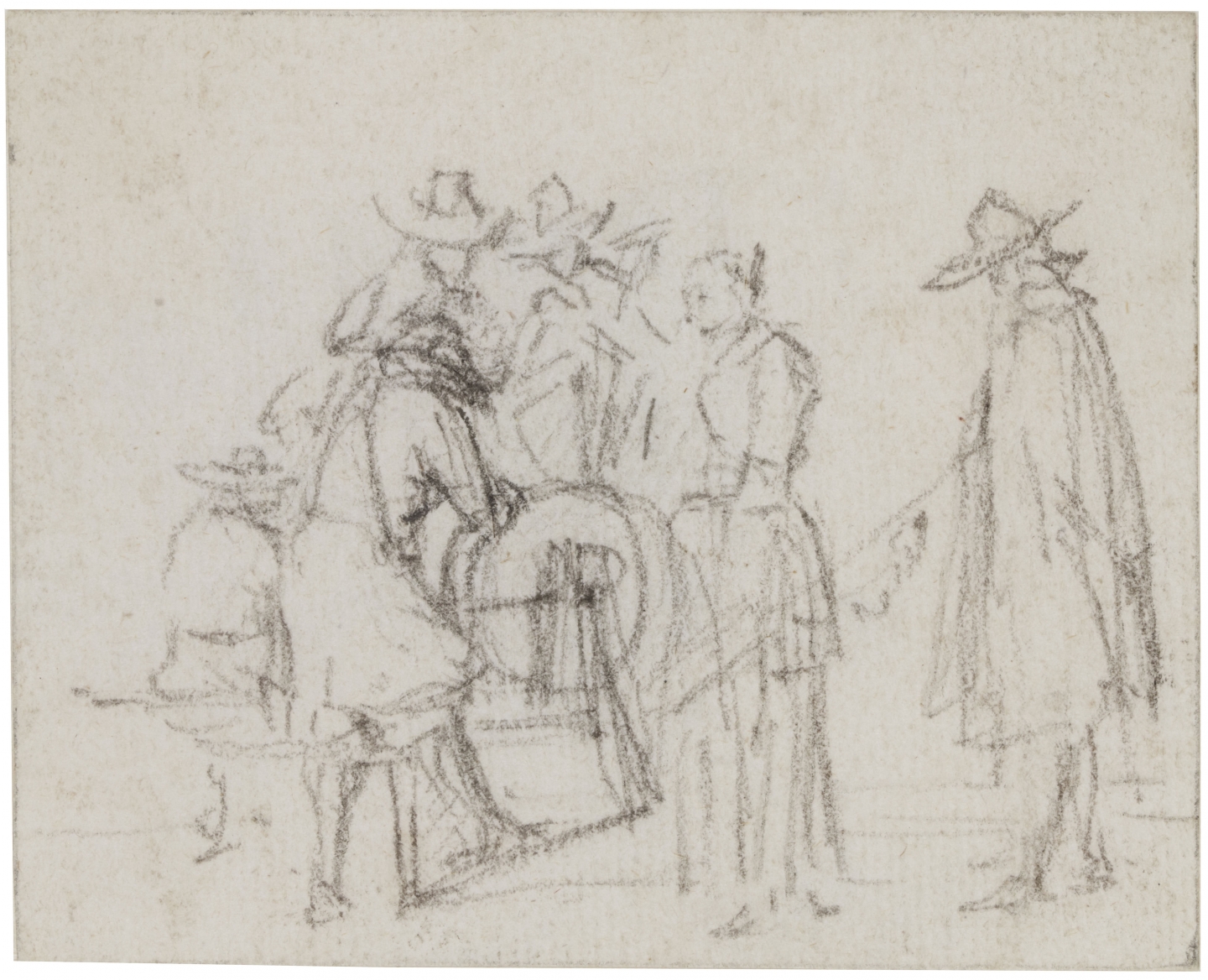
Trained by his father Gerard ter Borch Sr. (1582-1662), Moses is widely regarded as the most gifted and talented member of the ter Borch family. The present drawing together with the other drawing by Moses ter Borch in our collection are two recently discovered drawings from Moses' early youth and rare additions to the artist's relatively small oeuvre (about 200 drawings recorded in total) due to his prematurely death at the age of only 22 years old. They are considered to be amongst the earliest drawings recorded by Moses, probably dating as early as 1653-1657 between the age of eight and twelve years old. Moses often drew after prints by his favorite Old Masters like Dürer (1471-1528), Rembrandt (1606-1669) and Rubens (1577-1640).[1][2]
Moses' copy after the Catafalque of Emperor Matthias, the Holy Roman Emperor who died on 20 March 1619 by Jacques Callot (1592-1635) is a splendid example and both Moses and his elder brother Gerard ter Borch Jr. (1617-1681) copied after the print.[3] Gerard copied the print depicting the funeral held in S. Lorenzo, Florence in a more rigid manner. Moses on his turn copied after Gerard's copy after Callot.[4] Moses distinquishes himself from Gerard in the more personal and free expression of the rendering in his drawing and he also drew a free copy after Callot's La Ronde.[5]
The rendering of the figures and especially the legs and feet of both our drawings show striking similarites compared with Two men in conversation and a horse on the verso of the Annunciation to the shepherds sheet at the Rijksmuseum from the Ter Borch Estate.[6]
The feet show great similarities and can be closely compared with several sheets by Moses in the Ter Borch Estate of which the small oval drawing depicting the meeting of a bishop and soldiers before a castle or towngate is another striking example.[7]
From c.1660 Moses would commence the technique of red chalk, shortly later followed by drawing with black and white chalk on blue paper and execute the masterly self-portraits and portraits of his family members for which he is higly acclaimed.[8]
This small intimate drawing is a marvellous evidence of Moses' early talents, depicting a Scharensliep (old Dutch for a knife-grinder) with a well-to-do couple waiting while their scissors or knives are getting sharpened. The wife holding an eye on the proces, while her husband patiently awaits in the background to pay the bill in the end.
A warm thanks to Ilona van Tuinen for confirming the authorship for Moses Ter Borch.[9]
[1] Marjorie E. Wieseman, Ilona van Tuinen et. al., Thuis bij Ter Borch.
Museum de Fundatie, Zwolle, 2025. p.127-157.
[2] Alison McNeil Kettering, Drawings from the Ter Borch Studio Estate in the Rijksmuseum.
Staatsuitgeverij, 's Gravenhage, 1988. 2 vols.
[3] ibid. GJr24, p.104. Rijksmuseum Amsterdam, inv. no. RP-T-1887-A-1251
[4] ibid. M 27, p.302. Rijksmuseum Amsterdam, inv. no. RP-T-00-101
[5] ibid. M 28, p.302. Rijksmuseum Amnsterdam, inv. no. RP-T-1887-A-781
[6] ibid. M 80, p. 328. Rijksmuseum Amsterdam, inv. no. RP-T-00-57(R)
[7] ibid. M 20, p.298. Rijksmuseum Amnsterdam, inv. no. RP-T-00-583
[8] Gerard Ter Borch. Exhition catalogue to the exhibition at the Mauritshuis 9 March 1974- 28 April 1974. Mauritshuis, Den Haag, 1974. p.203-247.
[9] Ilona van Tuinen has confirmed the authorship for Moses ter Borch.
First hand inspection of the original, Amsterdam, 9 December 2025.