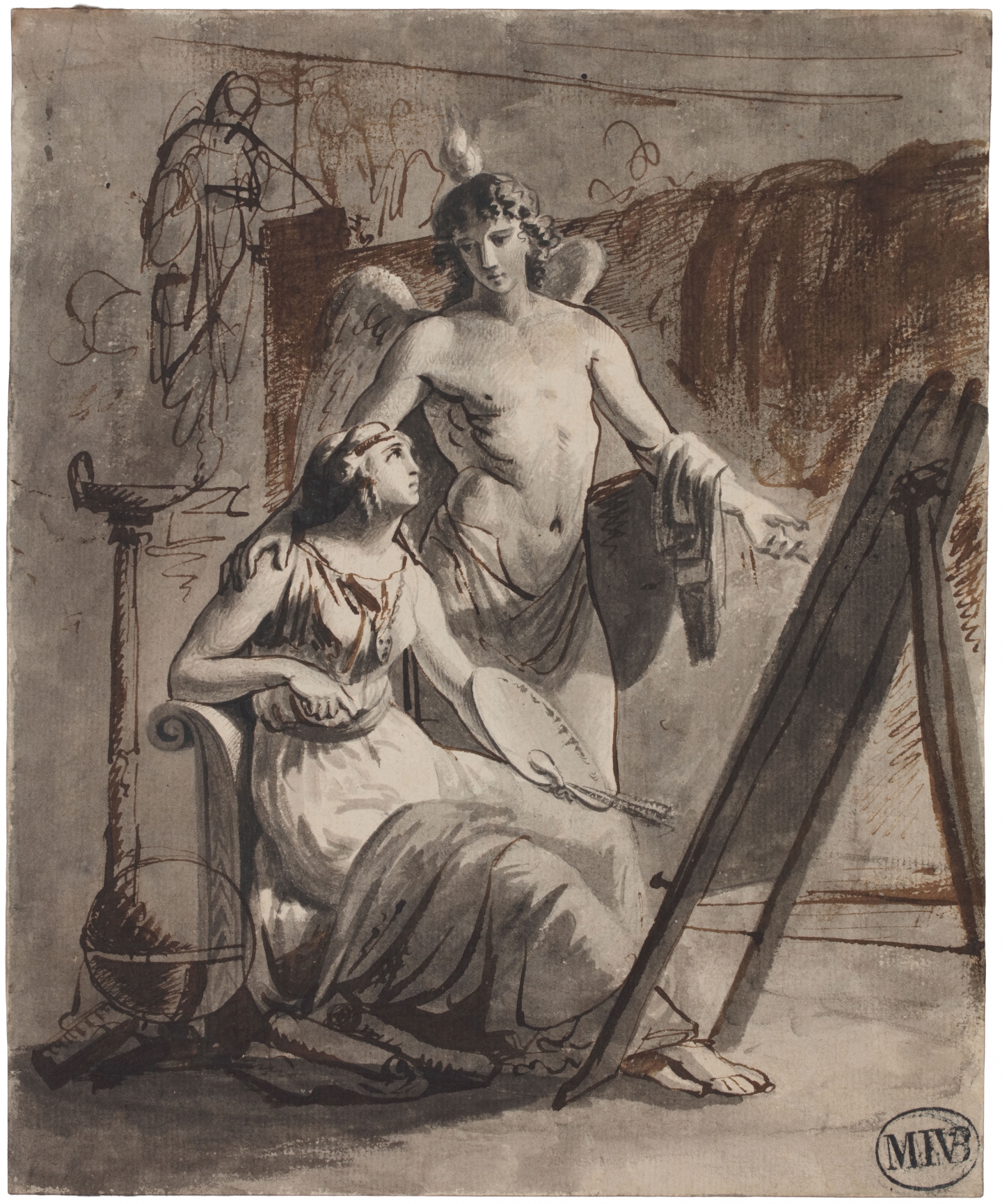
Already at the early age of only ten years old, Mattheus Ignatius van Bree is mentioned as a draughtsman at the Antwerp Academy. He was taught by Petrus Johannes van Regemorter. From 1794, as adjunct professor, had his own studio at the Academy. In 1797 he moved to Paris, where he continued his studies as a student of François-André Vincent. That year, he participated in the Paris Salon and won second prize in the Prix de Rome, awarded by the Paris Academy, for his depiction of The Death of Cato of Utica. He returned to Antwerp in 1804 and became a professor at the Antwerp Academy which had just been reopened after its closure by the French occupiers. Van Bree was after the end of French occupation in 1813 a member of the commission responsible for recovering works of art confiscated by the French and was able to retrieve many works by Rubens.
In 1821 he traveled to Italy and visited Florence and Rome with his former pupil Ferdinand de Braekeleer the Elder. In Florence he made in the Uffizi drawings after portraits by Leonardo da Vinci and Raphael. In the same year he also published his views on art in Leçons de dessin (Drawing lessons). From 1827 until his death, he became director of the Antwerp Academy after the resignation of Willem Jacob Herreyns.
He trained some of the eminent painters of the next generation such as Nicaise de Keyser, Jan August Hendrik Leys, Antoine Wiertz, Jules Victor Génisson and Ferdinand de Braekeleer the Elder, his brother Filip, Petrus van Schendel and Egide Charles Gustave Wappers. The latter succeeded him as director. Van Bree primarily painted portraits and historical genre pieces, such as his six-meter-wide painting The Self-Sacrifice of Mayor Van der Werff, which King William I donated to the city of Leyden in 1818 and is now housed in Museum De Lakenhal. Van Bree was also an etcher and lithographer. He died in 1839 at the age of 66.
This double-sided sheet is a very fine example of his mythological drawings. The recto shows Pictura, (depicted in the most classical style, with palette, painter's stick and necklace with the mask referring to the artist's ability to deceive reality through illusion. In the depicted version, Pictura receives instructing from an Angel instead of the classical scene being instructed by Minerva (Pallas Athena). The verso a study of Theseus and Ariadne.
[1] Van Eijnden & Van der Willigen, Geschiedenis der Vaderlandsche Schilderkunst, III (1820) p. 169-172