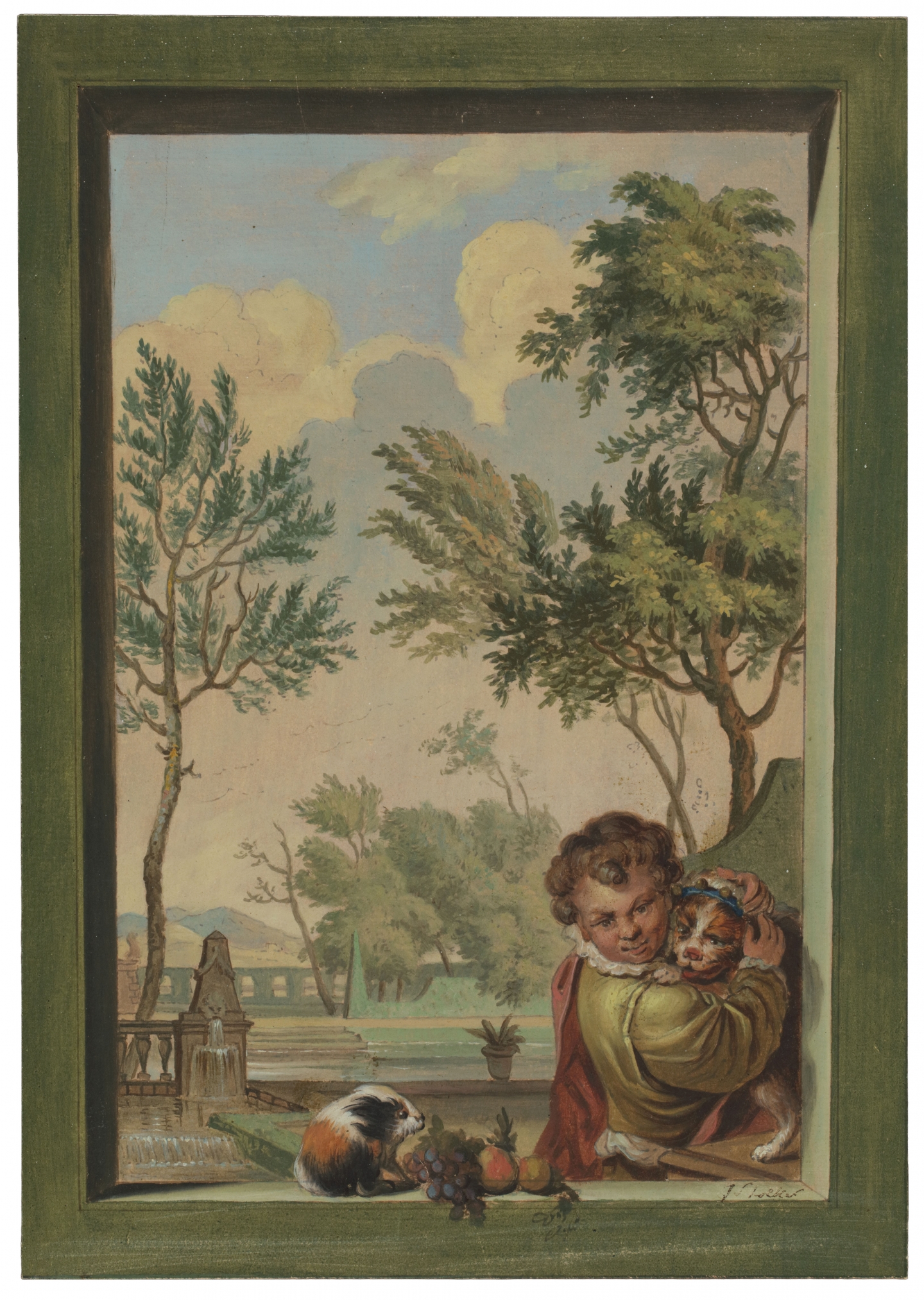
Stolker had an apprenticeship to the Amsterdam portrait painter Jan Maurits Quinkhard (1688-1772), after which Stolker was active in The Hague and Rotterdam. In Rotterdam he became member of the local Painters Guild where he was dean between 1766 and 1770. From 1774 on he dedicated himself solely to drawing in watercolour and gouache. These works he kept for himself and a large corpus of no less than a total of 75 of these sheets was mentioned in the inventory and his auction in 1786. The nature of these drawings were mainly copies after seventeenth century Old Masters, fantasy portraits of important artists and Reformation related pictures. Stolker also had close connections with the art dealer and draughtsman Cornelis Ploos van Amstel (1726-1798) who wrote a manuscript-biography on Stolker which was pasted down in a copy of De Roomsche Mogendheid by Joachim Oudaan in 1706. Ploos intended to make a reissue of the book with drawings by Stolker. Due to Stolker's death in 1785 these plans never were carried out. After 1774 he was mainly active as a dealer and restorator of paintings. It is well known Stolker (partly) used drawings and paintings of Old Masters for his own compositions, of which the present gouache is a striking examplel.[1][2]
Thanks to the rediscovery of a large corpus of drawings by Stolker in the inventory of Museum Boijmans Van Beuningen in 1992, the nature of his copying process has been disclosed.[3][4] Stolker applied with oil impregnated paper, which becomes translucent when dry to transfer small paintings. A less well-known procedure is the transferring of the (complete) composition of a varnished painting by repeating the contours with a mixture of oil and a pigment of choice on which a moist sheet of paper was applied to make an impression in reverse of the painting. Stolker finished these impressions with watercolour and gouache.
The present gouache is a striking example of a partly copy. Stolker copied the background for this Trompe L'oeil after Isaac de Moucheron (1667-1744), together with Jacob de Wit (1695-1754) one of his most admired and favourite artists.[5] He copied not in the same measurements, as the drawing by de Moucheron is considerably smaller (178 x 126 mm) about half the size our gouache.
The guinea pig on the balustrade clearly inspired by the painting of Frans Post (1612-1680) in the Rijksmuseum, where a little bird posts on the lower part of the painted framing and Cesar van Everdingen (1616-1678) and Pieter Post (1608-1669) where a little dog also tends to fool the spectator.[6][7]
A warm thanks to Charles Dumas for bringing the drawing by Isaac de Moucheron under my attention.
[1] RJ te Rijdt, Jan Stolker, in Kabinet der Heerlijkste Tekenwerken, Achttiende-eeuwse nederlandse tekeningen uit de verzameling van de Koninklijke Musea voor Schone Kunsten van België.
Koninklijke Musea voor Schone Kunsten van België, 2019. p.122-123.
[2] J.W. Niemeijer, 'Jan Stolker', in: Th. Laurentius, J.W. Niemeijer en G. Ploos van Amstel, Cornelis Ploos van Amstel 1726-1798. Kunstverzamelaar en prentuitgever.
Assen 1980, p. 179-186
[3] A.J. Elen, 'Onverbloemd kopiist Jan Stolker en zijn kunsthistorische documentatie'
Delineavit et Sculpsit 41 (mei 2017), p. 123-134
[4] A.J. Elen, 'Emanuel de Witte pinxit, Jan Stolker delineavit', in: E. Buijsen e.a. (red.), Kunst op papier in de achttiende eeuw/Art on Paper in the Eighteenth Century. Liber Amicorum aangeboden aan Charles Dumas ter gelegenheid van zijn 65ste verjaardag
Zoetermeer 2014, p. 80-91
[5] Sotheby Mak van Waay, 18-11-1985, lot. no. 195 and Sotheby's, London, 7-7-2011, lot. no. 174.
[6] Frans Post, Landscape in Dutch Brazil.
Oil on canvas, 282,5 x 210,5 cm.
Rijksmuseum Amsterdam, inv. no. SK-A-3224
[7] Cesar van Everdingen and Pieter Post, Graaf Willem II verleent het handvest aan het Hoogheemraadschap van Rijnland.
Oil on canvas, 218 x 212 cm.
Gemeenlandshuis van Rijnland.