Son of Herman Saftleven Senior (1580-1627) and younger brother to Cornelis Saftleven (1607-1681), Herman was born in Rotterdam in 1609. He was trained by his father and possibly by his elder brother Cornelis as well. On the 9th of May 1633 Herman married Anna van Vliedt and the couple settled in Utrecht, where Herman joined the St. Luke Guild in 1655 and would live the rest of his life. He collaborated with fellow Utrecht artists alike Cornelis van Poelenburch (1594-1667), Dirck van der Lisse (1607-1669) and Abraham Bloemaert (1566-1651).
His artistic development ranges from Herman's early works in the manner of van Poelenburch, Jan van Goyen (1596-1656) and Pieter Molijn (1595-1661) to the later wide Rhine river landscapes he made after his travels along the Rhine and Moezel in Germany. After the devastating storm of 1674 which destroyed numerous buildings and chruches in Utrecht, Herman made a series of drawings and prints as a memorial now present in the collections of the City Archives Utrecht. In his final years Herman worked for the collector and botanist Agnes Block (1629-1704), drawing the flowers from her celebrated botanical gardens at Vijverhof along the river Vecht nearby Utrecht. His daughter Sara Saftleven (1645-1702) was a flower painter as well.[1]
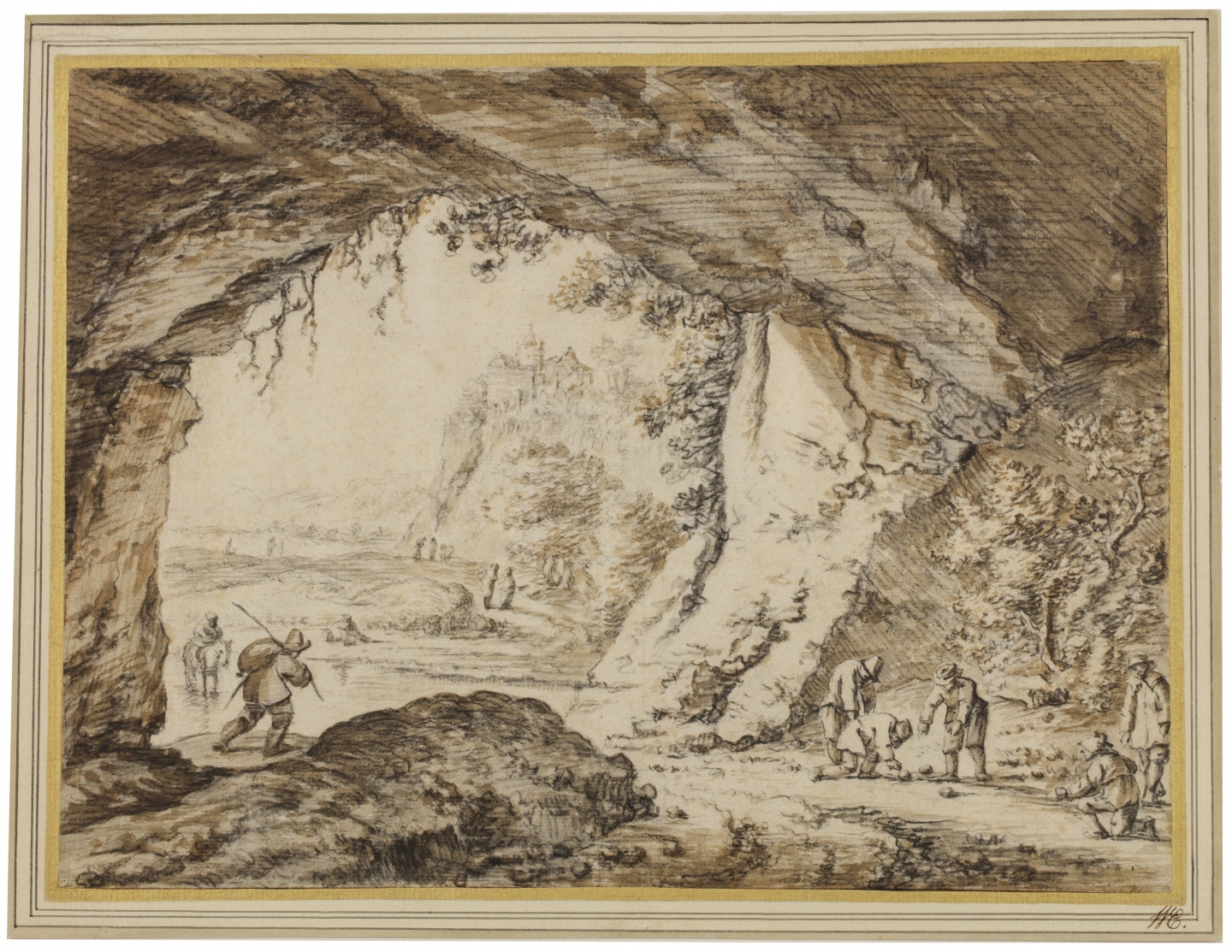
The present drawing depicts a most rare subject in Herman's oeuvre and shows Boccia players in a grotto, seen from the inside overlooking a fluvial landscape with travelers in the distance. A closely related drawing with stonemasons in a grotto is with the Crocker Art Museum, Sacramento.[2][3]
Boccia is an ancient target sport dating as early as c.5200 BC with roots in Egypt and Greece. The game is played with red or blue leather balls, which the participants are supposed to throw as close as possible to a white target ball or jack. The game is closely related to pétanque.
Although Wolfgang Schulz dates the group of landscape drawings between 1648 and 1652, the 1648 dated drawing in Sacramento is so closely related in subject, composition, rendering and cross-hatching, a date of 1648 is most likely for our drawing.
[1] Wolfgang Schulz, Herman Saftleven 1609-1685 : Leben und Werke, mit einem kritischen Katalog der Gemälde und Zeichnungen. Berlin, De Gruyter, 1982
[2] Ibid. no.788 on p.336
[3] Herman Saftleven, Stonemasons inside a grotto.
Black chalk, brown and grey wash, 221 x 278 mm.
Crocker Art Museum, Sacramento, inv. no. 1871-161