David Pièrre Giottino Humbert de Superville was born on 20 July 1770 in The Hague as the son of the Swiss/French painter Jean Humbert (1734-1794) and Elisabeth Antoinette Deel. David added the surname of his grandmother Emilie de Superville to his own name. Giottino, was originally a nickname given to him in Italy because his work showed similarities to the Italian master Giotto di Bondone (1266/67-1337). David registered at the Drawing Academy of The Hague in 1781 and became member of Pictura Hagensis. Having won the first prize at the academy in 1788, he travelled to Italy, financially supported by W.A. Lestevenom, old ambassador of France, where a new form of art was emerging, strongly influenced by classical antiquity and Renaissance art. The works of art that he encountered in Rome, and particularly those of the early Italian artists, strongly influenced Humbert’s development as an artist and a theorist. During his stay in Italy, Humbert made various studies and sketches of ancient works of art and highly expressive portraits, such as the series of portraits of Gagliuffi (during his imprisonment at Civita Vecchia).
In Rome he meets William Young Ottley, who lived in Italy since 1791. Together they travel to Tuscany and Umbria to study early frescoes. Ottley stole Humbert's drawings and published them without his consent and the drawings finally ended up at the Academia in Venice.
During the raids in Rome around 1798 Humbert was imprisoned at Cevita Vecchia for over four months by the army of the pope, cause he sympathised with the French. This prison period had a devastating influence on his health. After his release and a short stay in Paris, he returned to the Netherlands in 1802 where he joins the Amsterdam based Felix Merites. First he found a job as a drawing teacher to military students in Enkhuizen and Rotterdam, later, after moving to Leiden, as the director of the Leiden drawing academy, Ars Aemula Naturae.
David marries Anna Elisabeth Paradijs (1788-1817) on 17 October 1816 and the couple had two a twin and dramatically Anne dies at childbed.
In 1825 he was appointed the first director and curator of the Print Room and the Cabinet of Plaster Casts of Leiden University, housing the collection of Johanna Louisa van Oldenbarnevelt and her husband Jean Theodore Royer. A directorship he would fullfil til the very end of his life. He further developed his theories on the historical development of art and published his Essai sur les Signes inconditionnels dans l’Art in 1827. In the last few years of his life, Humbert’s drawings acquired a very dramatic and visionary character comparable to the works of Johann Heinrich Fuseli (1741-1825) and William Blake (1757-1827). Humbert died on 9 january 1849.
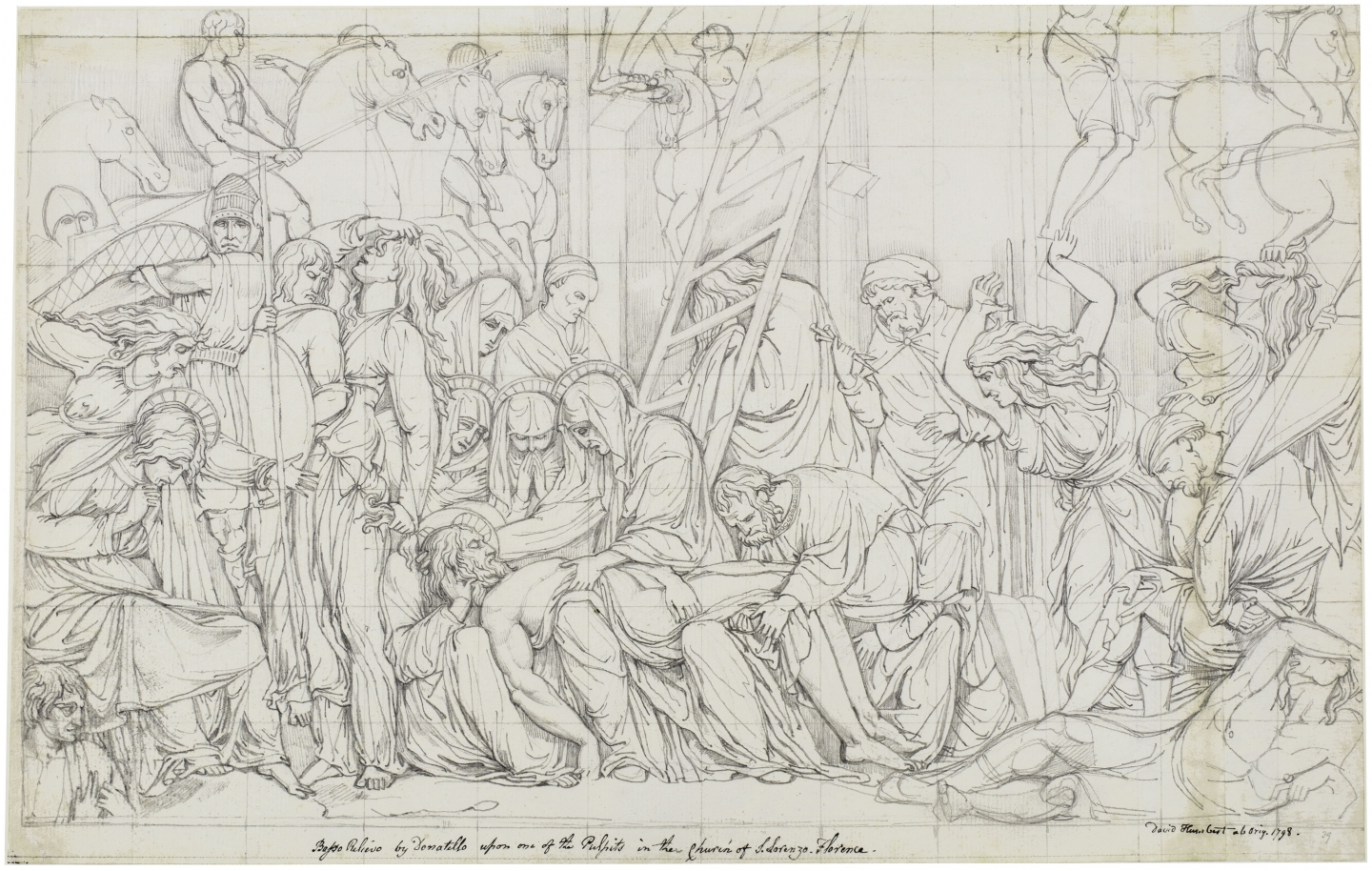
This large and attractive drawing is a copy of Donatello's relief of the Deposition (c. 1460) on one of the finest pulpits he created with his workshop. The drawing has the grid used for the engraving by Sartain for Ottley's 1826 book (Brigstocke 2010, #40)
[1] W.Y. Ottley (Thatcham 1771-Londra 1836), D.P. Humbert de Superville (L'Aja 1770-Leida 1849) ed altri. Viaggio da Roma alla riscoperta dei Primitivi. Antichità Alberto Di Castro, Firenze, 2013.