Anthonie enrolled to the Amsterdamsche Stads Teeken-akademie (Amsterdam Drawing Academy) in 1766 where he was taught the art of drawing. He was also taught by his elder brother Jurriaan Andriessen (1742-1819), who he assisted in his workshop where Jurriaan painted wallpapers. Anthonie also gave drawings lessons, amongst others to Wouter Johannes van Troostwijk (1782-1810). In the early stage of his career, c. 1770-1772, Anthonie was active as a topographical draughtsman, influenced by 17th century Marine painters like Hans Goderis (1598/1600-1632/38), Ludolf Backhuysen (1630-1708), Abraham Storck (1644-1708) and Jan Claes Rietschoof (1652-1719). Anthony (or Anthonie) exclusively drew and not a single painting by his hand has been recorded.[1][2]
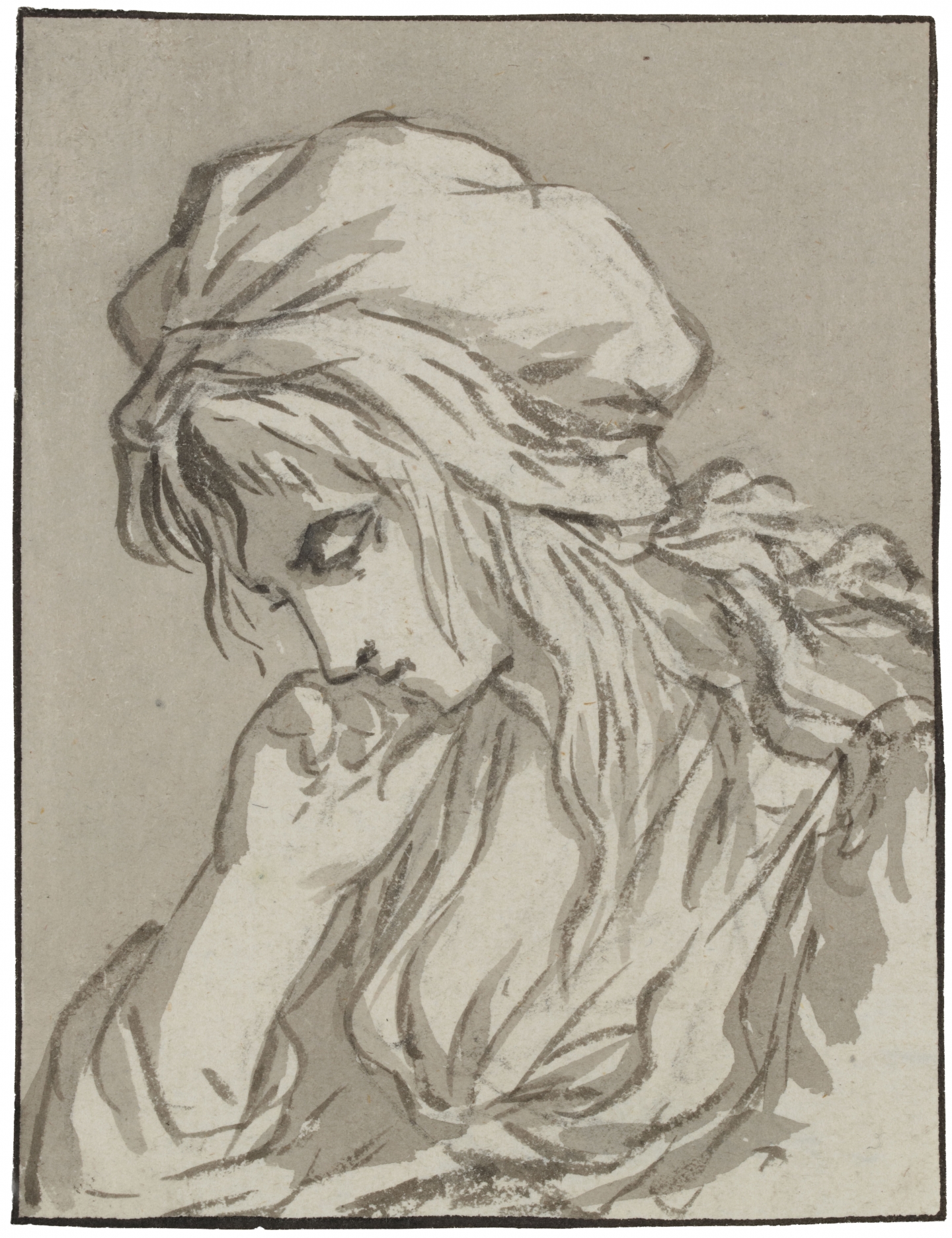
Clearly recognisable cause of her sloping and pointy nose, wearing an identical cap, the model in our drawing also appears in a drawing at the Rijksmuseum, as a seated mother with a little girl, drawn in profile where she rests her head on her right hand in similar pose, gazing into the far distance.[3]
Most assumptuous, the slightly larger sheet in Amsterdam is the pensiero or first study, substantiated by pentimento in her upper right leg, position of her right foot and a very swiftly sketched minimal background.
The outlines of the Amsterdam study have been drawn in pen and ink, creating a slightly more rigid rendering. This recently discovered portrait of the same model has been drawn fully with the tip of the brush, creating a more painterly nature, which makes it a loosely executed portrait. Anthonie added lavishly play of light and shadow, by repeating the swiftly drawn countours with brush and wash.
Contrary to the sheet in Amsterdam, where the background has been left fully blank, Anthonie used grey wash for the background, adding considerably more intimacy to this small and passionate drawing. The drawing proudly signed on the verso, clearly indicating it to be meant for the art market.
Obviously, Anthonie favoured the pose as a study of two children of which the left in the same angle and pose was on the market several decades ago in Amsterdam.[4]
[1] Van Eijnden & Van der Willigen, Geschiedenis der Vaderlandsche Schilderkunst, III (1820) p. 14
[2] Charles Dumas, Anthonie Andriessen, in Kabinet der Heerlijkste Tekenwerken, Achttiende-eeuwse nederlandse tekeningen uit de verzameling van de Koninklijke Musea voor Schone Kunsten van België.
Koninklijke Musea voor Schone Kunsten van België, 2019. p.126-127.
[3] Anthony Andriessen, Zittende moeder met meisje.
Pencil, pen and grey ink, grey wash, 134 x 100 mm.
Rijksmuseum, Amsterdam. inv. no. RP-T-00-821
[4] Anthony Andriessen, Study of the Heads of two Children.
Brush and grey ink, grey wash, 132 x 141 mm.
Sotheby's, Amsterdam. 16 November 2005, lot. #200