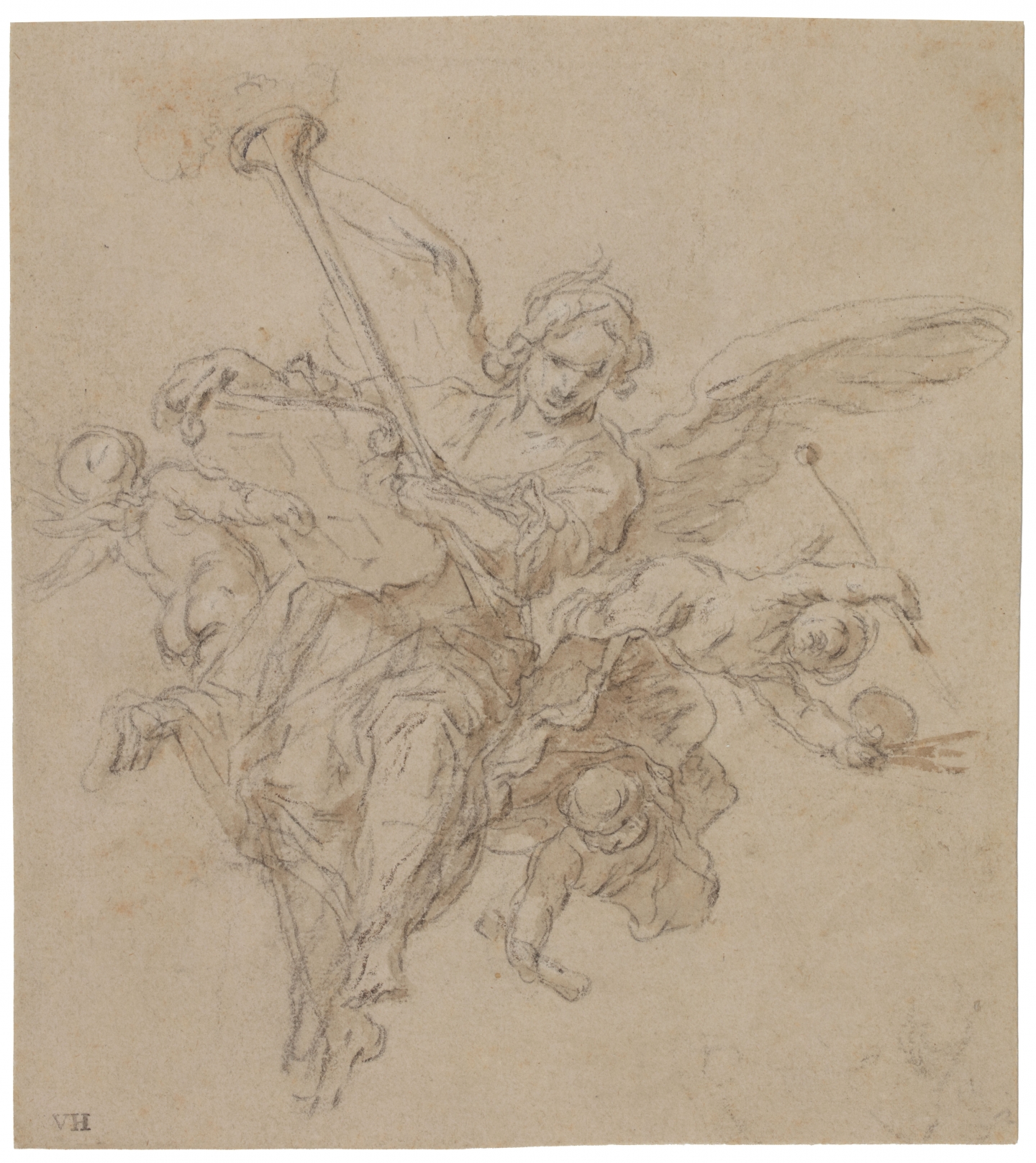
The Guild of Saint Luke was the brotherhood of artists and craftsmen under the patronage of Saint Luke, referring to the evengelist Luke. His spirit considered to be the most evocative, with attention for detail. A broad variety of artists was allowed to become member of the Guild, from painters, stained-window artists, engravers, potters, printers and art dealers. The Guild finds it's origins in Antwerp and was established in 1382 and spread through the Southern and Northern Netherlands. In 1611 a group in Utrecht separated from the Zadelaarsgilde and proceeded by the name of the Guild of St. Luke, for visual artists of which Paulus Moreelse (1571-1638) and Abraham Bloemaert (1566-1651) ware amongst it's founding members.
Abraham Bloemaert was one of the founding members of the St. Like Guild of Utrecht in 1611 and became it's dean in 1618. Abraham drew the subject with the Coat of Arms of St. Luke several times, of which three versions have been recorded by Dr. Jaap Bolten.
One version, depicting Fama with her Trumpet, holding the Coat of Arms of the St. Luke's Guild with no less than nine putti holding the instruments of the Arts, dated 1647 is in Uppsala.[1][2]
A second slightly sketchier related drawing with seven putti and other formal variations especially in the figure of Fama is in Brussels.[3]
Our drawing is the pensiero or first version for both later inventions and depicts Fama in a position corresponding to the Uppsala drawing with three putti.
Bolten also mensions two related drawings.[4][5]
[1] Dr. Jaap Bolten, Abraham Bloemaert c.1565-1651, The Drawings.
2007, Privately Printed.
[2] Abraham Bloemaert, Title or Frontispice: Fama with her Trumpet, holding the Coat of Arms of the St. Luke's Guild: and nine Putti holding the Instruments of the Arts, 1647.
Uppsala, Universitetsbiblioteket. inv. no. SE 751 20 Uppsala.
[3] Abraham Bloemaert, Schwebender Engel mit Posaune, umgeben von sieben Putten met Attributen.
Pen and brown ink, brown wash, white bodycolour, 185 x 235 mm.
Guy Grieten collecion, Brussels.
[4] ibid. no. 629
[5] ibid. no. 1065